

Hand Tendon Injury
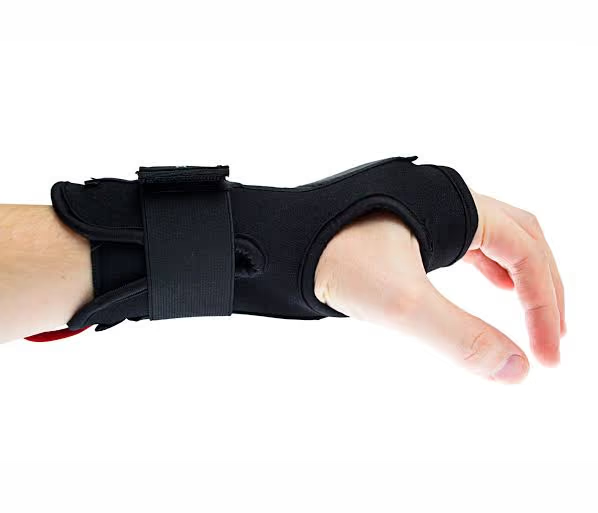
Targeted hand therapy to restore fine motor function, relieve pain, and heal your hand injuries safely and effectively.

De Quervain’s Tenosynovitis
De Quervain's tenosynovitis affects the tendons on the thumb side of your wrist. Left untreated, it can make simple tasks like turning a key, lifting a kettle, or gripping objects incredibly painful.
What is it ?
This condition is an inflammation or thickening of the sheath surrounding two specific tendons (the abductor pollicis longus and extensor pollicis brevis) that control thumb movement. Symptoms present as sharp or aching pain at the base of the thumb that radiates up the forearm, often accompanied by mild swelling and a catching sensation when moving the thumb.
How is it caused?
It is driven almost entirely by repetitive overuse of the wrist and thumb. It is extremely common in new mothers (often dubbed "Mommy Thumb") from repeatedly lifting a growing baby. It is also frequently triggered by occupational hazards involving heavy gripping, repetitive hammering, or spending excessive hours using a computer mouse or smartphone.
How is it managed?
Conservative hand therapy is highly effective. Management involves immediate mechanical offloading using a custom-fitted thumb-spica splint to immobilise the affected tendons. Our Hand Therapist will guide you through progressive, pain-free tendon-loading exercises as the inflammation settles. If the condition is severe or chronic, we work collaboratively with GPs to facilitate a corticosteroid injection to rapidly reduce tendon sheath swelling alongside therapy.
A mallet finger is a highly specific tendon injury that completely compromises the ability to straighten the very tip of your finger.
It is an injury to the extensor tendon at the distal interphalangeal (DIP) joint—the joint closest to the fingernail. When this tendon is ruptured or avulsed (pulled off with a small piece of bone), the fingertip droops downward and cannot be actively straightened by the patient, though it can easily be pushed straight by the other hand.
This is typically an acute traumatic injury. It most commonly occurs when a ball (like a basketball, baseball, or cricket ball) forcefully strikes the tip of a fully extended finger, forcing it to bend further than it is designed to go and snapping the extensor tendon.
Management requires strict, uninterrupted splinting. Our Hand Therapist will custom-make a small thermoplastic splint that holds the very tip of the finger perfectly straight while leaving the rest of the finger free to move. This splint must be worn 24/7 for 6 to 8 weeks to allow the tendon ends to heal back together. If the finger droops even once during this period, the healing process is compromised, and the clock resets. Surgery is rarely required unless there is a significant displaced bone fracture involved.
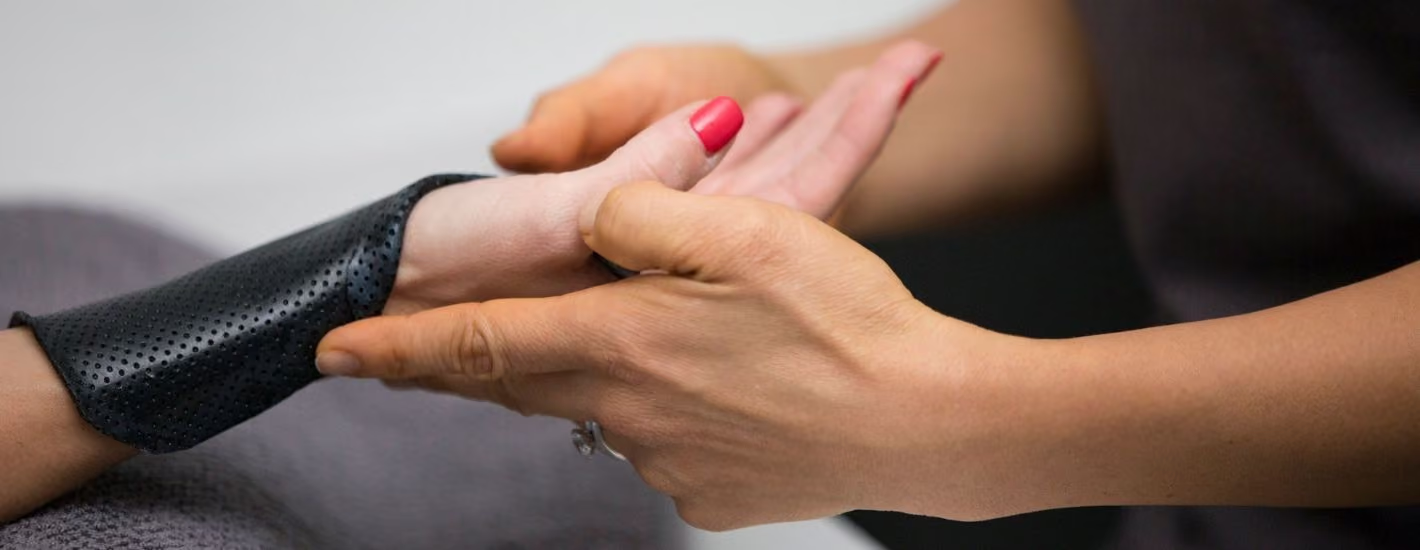
Trigger finger is a frustrating and painful condition where one of your fingers gets stuck in a bent position before suddenly snapping straight.
Trigger finger involves the flexor tendons that bend your fingers. These tendons glide through a series of tunnel-like sheaths (pulleys). When the tendon becomes irritated, it can form a small nodule. This nodule catches on the opening of the tunnel (the A1 pulley) at the base of the finger, causing the finger to lock or click painfully as you try to straighten it.
It is generally caused by repetitive, forceful gripping or sustained pressure on the palm of the hand. It is common in tradespeople using heavy power tools, avid gardeners, or musicians. Individuals with underlying medical conditions, such as diabetes or rheumatoid arthritis, have a significantly higher risk of developing trigger finger.
We manage trigger finger through custom splinting that blocks the specific knuckle from bending all the way, preventing the nodule from catching in the pulley while the inflammation resolves. Your therapy will include targeted tendon-gliding exercises to maintain hand mobility without irritating the tendon. In stubborn cases, we coordinate with your doctor for a cortisone injection to shrink the nodule, or a surgical release if conservative options have been exhausted.
A Boutonniere deformity is a complex structural issue that severely impacts the biomechanics and appearance of the finger.
This condition results in a distinct physical deformity: the middle joint of the finger (the PIP joint) bends inward (flexion), while the end joint (the DIP joint) hyperextends outward (extension). It occurs when the "central slip" of the extensor tendon tears, causing the lateral bands of the tendon to slip down the sides of the finger like a buttonhole (boutonnière in French).
It is typically caused by a forceful blow to the top of a bent middle joint, often occurring in contact sports or falls. It can also be caused by a deep laceration to the back of the finger that severs the central slip, or it may develop progressively over time due to inflammatory conditions like rheumatoid arthritis.
Early and highly precise splinting is critical to prevent the deformity from becoming permanent. Our Hand Therapist will fit you with a specialised splint that holds the middle joint fully straight for 3 to 6 weeks, allowing the torn central slip to heal. Crucially, during this splinting phase, you will be given specific exercises to actively bend the very tip of the finger; this prevents stiffness and helps pull the lateral tendon bands back into their correct anatomical position.
Who treats this?
Our experienced team members are ready to help. See their bios below and book online when ready.
.avif)
All major health funds accepted
Private health claiming via Tyro Health EFTPOS terminal











FAQ

No, you do not need a GP referral to book a consultation with our Hand Therapist as a private patient. However, if you are seeking treatment under Workers Compensation, Compulsory Third Party (CTP) insurance, or a Medicare EPC plan, you will need to bring a valid referral from your doctor.
No, we do not bulk bill. You are required to pay the full consultation fee at the time of your appointment. However, we will immediately process the Medicare claim on your behalf, and your Medicare rebate will be deposited directly into your nominated bank account (typically within 24 to 48 hours).
Musicians are particularly susceptible to Trigger Finger and De Quervain's tenosynovitis. Playing instruments like the guitar, piano, or violin requires repetitive, forceful gripping, sustained pressure on the fingertips, and rapid thumb movements. Over time, this repetitive strain can easily inflame the flexor tendons (leading to Trigger Finger) or the thumb tendon sheaths (leading to De Quervain's).
Yes, absolutely. Strict, uninterrupted splinting is the only way a mallet finger can heal without surgery. The splint must be worn 24 hours a day, 7 days a week, for 6 to 8 weeks. If you take the splint off to wash your hand and the fingertip droops even for a single second, the fragile new healing tissue will tear, and your 6-to-8-week recovery clock resets completely to day one. Our Hand Therapist will teach you exactly how to safely change the tape and clean the finger without letting the joint drop.